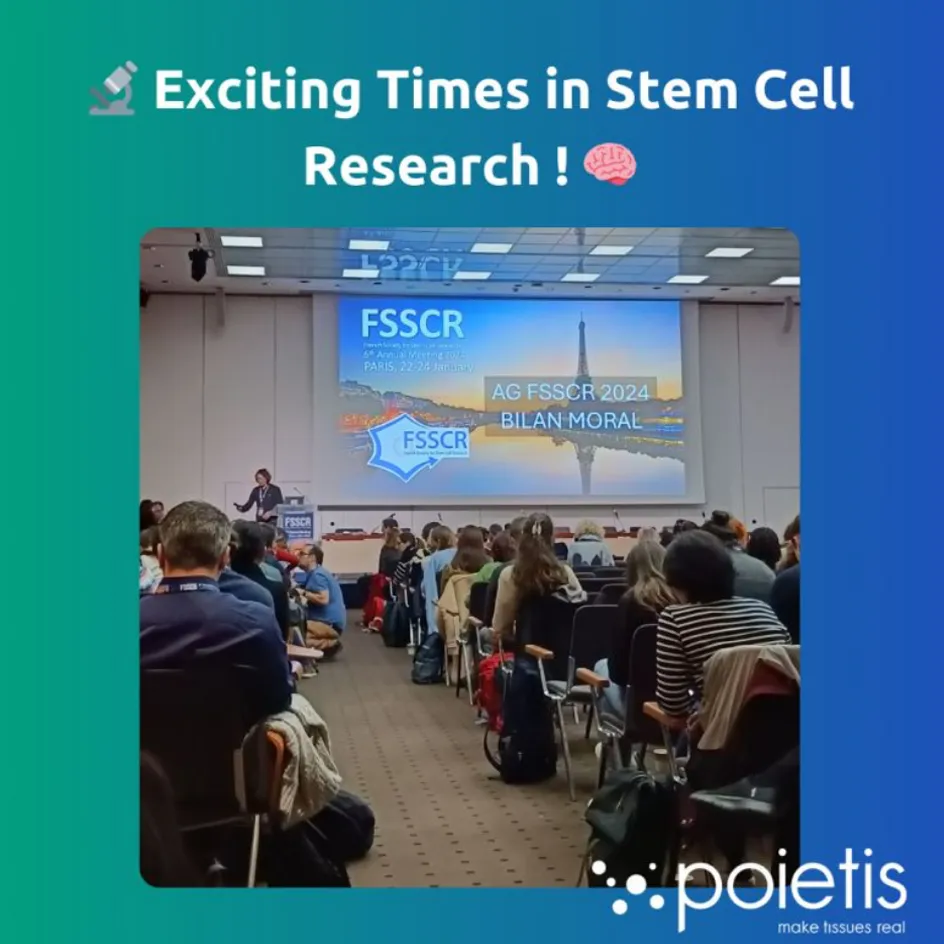
At the Next-Generation Organoids colloquium of the La Santé à 360° congress in Poitiers, our Director of R&D Antonio Iazzolino presented laser-assisted bioprinting for scalable, reproducible organoid-based tissue engineering.
From 1 to 3 July 2026, Poietis Biosystems joined La Santé à 360°, the first congress of the HR2S network at the University of Poitiers.
The congress gathered roughly 600 participants around a One Health vision, spanning human, animal, environmental and technological health. Within it, one thematic colloquium spoke directly to our platform: Next-Generation Organoids: Materials, Models and Biomedical Applications, which brought chemists, physicists, biologists and clinicians around the same set of questions - how to standardize 3D models, advance personalized medicine, and reduce animal experimentation.
We were there to contribute the missing piece between growing an organoid and manufacturing a reproducible tissue: laser-assisted bioprinting.
Antonio Iazzolino: laser-assisted bioprinting for organoid-based tissue engineering
On Friday 3 July, in the session Organoids and biofabrication: from the laboratory to industrial innovation, our Director of R&D Antonio Iazzolino gave a talk titled "AI-Driven Laser-Assisted Bioprinting for Scalable Organoid-Based Tissue Engineering."

The message was a case for light. Laser-assisted bioprinting places cells and fragile 3D objects - spheroids and organoids - without a nozzle, at high resolution, and without the shear stress that damages living material where nozzle-based extrusion tends to. Guided by AI and driven by the automation of the NGB platform, the same process manipulates and assembles those building blocks into structured tissues, with a level of reproducibility and throughput that manual handling cannot match.
This is the bottom-up route to tissue engineering: assemble validated building blocks rather than print everything at once. It extends directly from Antonio's peer-reviewed work on laser-assisted bioprinting of cartilaginous spheroids (Biofabrication, 2024) - from the spheroid to the organoid, the same paradigm, one step further.
Why it mattered at this colloquium
The colloquium set out to structure the organoid community and push toward standardization, personalized medicine and predictive models. Producing organoid-based tissues in an automated, reproducible and scalable way is a prerequisite for that predictivity - in screening as much as in personalized medicine. It also fits the session's own theme: the move from the laboratory to industrial innovation, mirrored in our own continuum from the NGB-R® research system to the NGB-C® clinical-grade platform.
Thank you to the HR2S network and the organizers for a colloquium that put chemistry, physics, biology and the clinic in the same room. Conversations started in Poitiers are exactly the ones we came for.
Working on organoid or spheroid models and thinking about reproducible, scalable biofabrication? Let's talk.
Projected use on NGB
The same laser-assisted process runs on the NGB-R® research platform and continues on the GMP-grade NGB-C® for clinical translation. Map this to your own model →